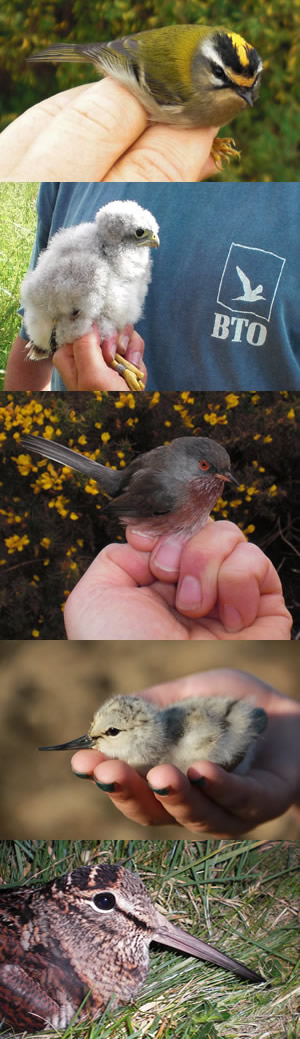
BIRD RINGING |
Bird ringing (called bird banding in the USA) is administrated in the UK by the British Trust for Ornithology (BTO), and it is an effective and safe method of studying wild birds. Birds are caught in a variety of nets, or by hand, and many are ringed as nestlings. Individually numbered, lightweight rings are then placed on their legs. The information gathered from subsequent retrapping or recovery of ringed birds gives us a huge amount of information on life expectancy, migration routes etc.
Graham is a BTO Licensed Bird Ringer and Trainer, and he has been ringing birds since 1990.
Here are some examples of the results of Graham's ringing studies.
Little Egret
A Little Egret that Graham ringed as a chick in June 2006 holds the UK longevity record for the species. It is now over 13 years of age and it is regularly seen (recognised by its colour rings) on the Lymington Marshes in Hampshire. The previous oldest Little Egret died at 9 years and 6 months.
Avocet
See separate page.
Woodcock
Following excellent work in France by French bird ringers, a small number of British ringers now catch good numbers of woodcock in the UK. Graham has been ringing woodcock at farmland and New Forest sites. The latter is part of the New Forest Woodcock Group's study. The data collected is also shared with national study groups and other woodcock study groups across Europe.
Some remarkable migrations have been recorded, with 7 of Graham's Hampshire ringed woodcock having been found in Russia, 2 in Finland, 1 in Germany, 1 in Belgium and 2 in France.